Head-to-head
TrackPlay vs Voomly
Pick TrackPlay if you run paid traffic to a VSL and buy media on the sale, so you need every play tied to the cart-verified purchase and posted back to Meta, TikTok and GA4; pick Voomly if you want to make the videos and host them cheaply with unlimited bandwidth in one suite, and your player only needs basic engagement stats.
Quick answer
Pick TrackPlay if you run paid traffic to a VSL and buy media on the sale, so you need every play tied to the cart-verified purchase and posted back to Meta, TikTok and GA4; pick Voomly if you want to make the videos and host them cheaply with unlimited bandwidth in one suite, and your player only needs basic engagement stats.
| TrackPlay | Voomly | |
|---|---|---|
| Best for | Paid-traffic VSLs | Creation + hosting |
| From | $29/mo | $9/mo |
| Billing | Per play | Flat tiers |
| Free plan | 1,000 plays/mo | Light: 5 videos |
| Sale attribution | Server-side postbacks | None |
Where TrackPlay pulls ahead
What works
- Split tests are settled on the cart-verified sale, with a p-value and confidence interval, and variants run under one embed, so your ad links and campaign learning never reset.
- Conversions post back to Meta, TikTok and GA4 server-side on the watch-time milestone you choose, so the ad platform optimizes on real sales instead of a page-load pixel.
- Per-second retention is split into buyers and non-buyers, with hook rate, hold rate and revenue per play, so you can see the exact seconds to cut or protect.
- Every feature is on every plan and billing is on plays, not bandwidth or seats. The free plan is 1,000 plays a month with no card, and paid plans start at $29.
What to watch
- It is narrow by design: built for paid-traffic VSL conversion, not general hosting, so it lacks the channels, SEO pages and webinar tooling of a Wistia. If your video's job is content marketing, use a general host for that job. For a cold-traffic VSL you still get the full player, per-second retention and sale attribution it is built around.
- It is very new, so outside proof is thin: the testimonials are on-site, there is little third-party review footprint yet, and signup is invite-only right now. That is what you would expect of a platform this recent, and the free plan lets you judge it on your own numbers before you spend on traffic.
What you are actually choosing between
Both of these host your video and give you a player for a landing page, so on a shortlist they can look interchangeable. They are not. They are built for two different jobs, and which one you should pick depends on what your video is for.
TrackPlay is a VSL player and analytics platform built for paid-traffic funnels. It hosts the video behind one embed that drops into any funnel builder, holds attention with sound-first autoplay and timed calls to action, and ties every second watched to who actually bought. Its focus is attribution: when the sale happens, the cart posts the verified purchase back onto the play that earned it, and TrackPlay fires that conversion server-side to Meta, TikTok and GA4. Split tests are decided on real sales rather than clicks.
Voomly comes at the problem from the other end. It is a video creation suite that also hosts. It bundles tools to make the video, such as Doodly, Toonly and Talkia, and then hosts it with a player, engagement graphs and heatmaps. Its paid plans include unlimited bandwidth, and it starts at $9 a month, the cheapest entry in this comparison. That origin, a creation suite first and a conversion player second, is what the whole matchup turns on.
The two players
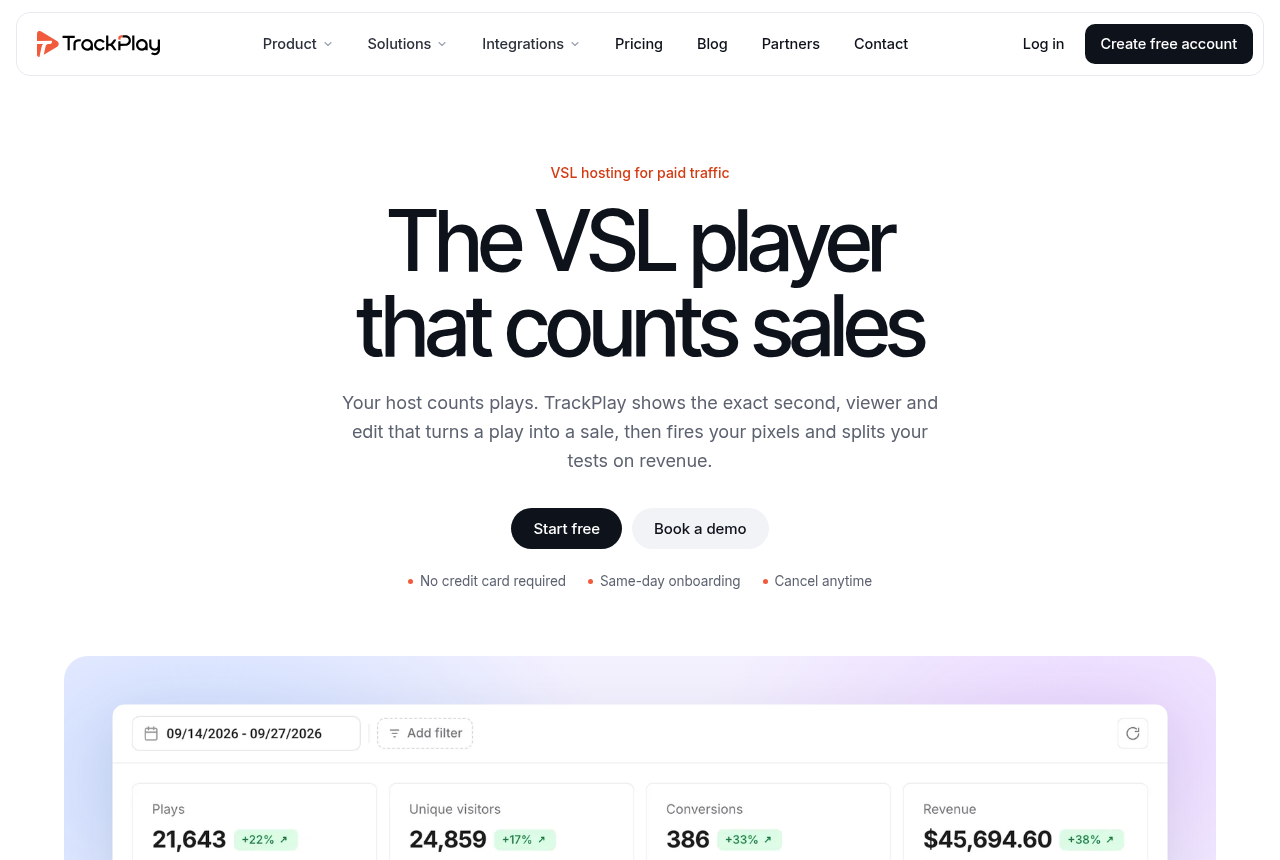
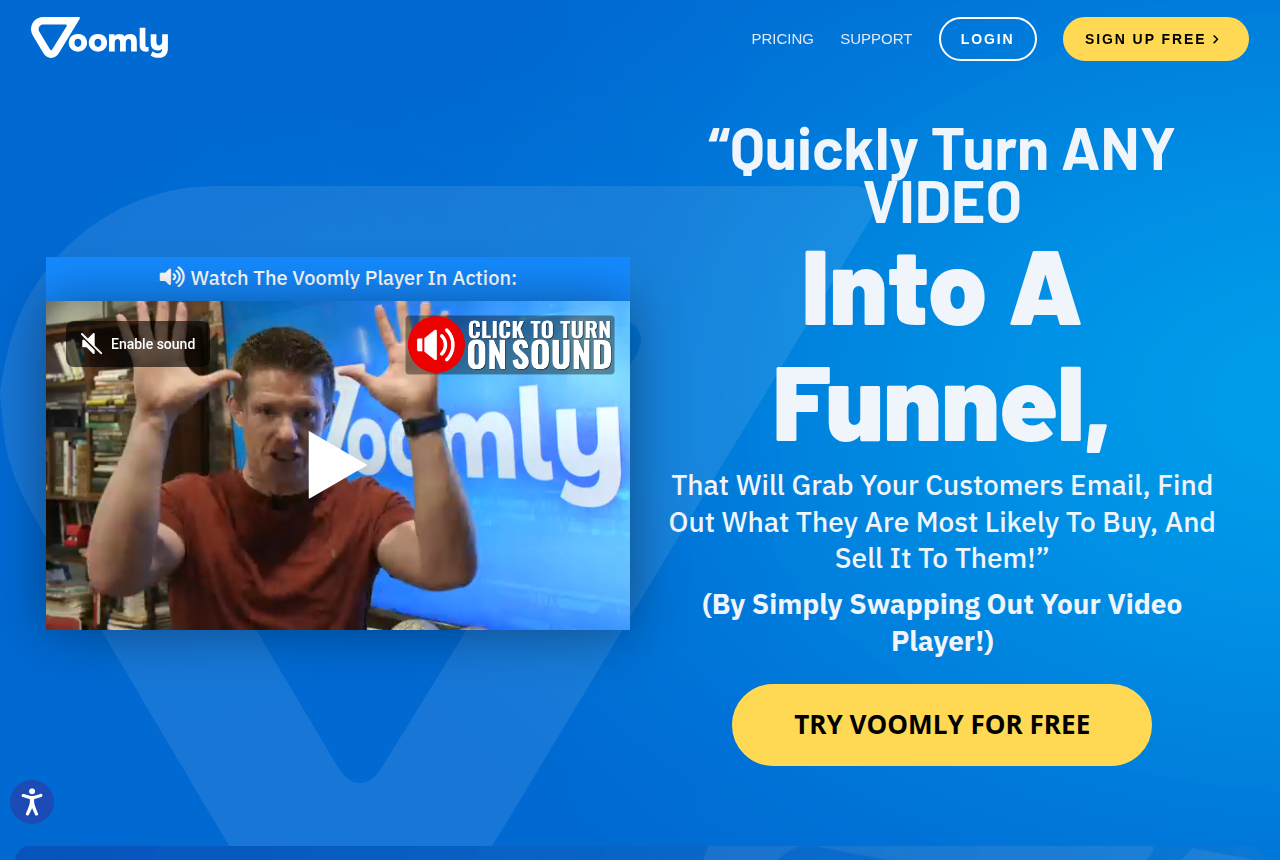
TrackPlay's player is built to hold a cold viewer. Its Smart Autoplay is sound-first: where the browser allows sound, it plays with sound from the first frame; where it does not, it starts muted and turns sound on at the viewer's first touch without restarting the video, so the hook is heard rather than replayed. It reports unmute rate as a metric. On top of that it adds timed CTA cards, watch gates that hold content until a chosen second, and lead capture forms over the video.
Voomly's player is capable and clean, with autoplay, custom thumbnails, calls to action and a video-funnel feature to chain videos. But its conversion features are basic next to a dedicated direct-response player. It gives you what you need to present a video well; it does not go as deep on the paid-traffic tricks, and it has no equivalent of the buyer-versus-non-buyer view below.
Analytics and attribution: the real split

This is the line that decides the matchup for a paid-traffic seller. Voomly's analytics are engagement graphs and heatmaps. They show you how a video is watched, where attention drops, which is genuinely useful for editing. But they stop there. Voomly does not tie a play to the actual sale, it has no pixel postbacks, and it does not report retention split by whether the viewer bought.
TrackPlay is built around exactly that gap. It draws retention per second and splits it into buyers and non-buyers, with the median pitch moment marked on the curve, alongside hook rate, hold rate and revenue per play. That last metric reframes the whole report: it tells you what a play is worth, not just how many plays you got. You can see the exact seconds that earn money and the ones to cut.
Then it does the thing Voomly does not attempt. When the sale lands, the cart posts the verified purchase back onto the play that earned it, server to server, with no browser involved. TrackPlay reads that from seven direct-response carts, including ClickBank, ClickFunnels, Kiwify, BuyGoods, Digistore24, WarriorPlus and JVZoo. It then fires that conversion server-side to Meta CAPI, TikTok Events API and GA4 on the watch-time milestone you choose, and dedups the browser and server events so you do not double-count. The practical effect: your ad platform optimizes on the actual, cart-verified sale and on watch behaviour, instead of on a page-load pixel that fires whether or not anyone watched. If your buying decision is driven by what Meta and TikTok learn from your traffic, that attribution is the clearest reason to prefer TrackPlay here, on top of the player and per-second retention you get from it either way.
Split testing
Both can put two versions of a video in front of traffic. Voomly's testing tells you which variant held attention better. TrackPlay decides its tests on the cart-verified sale with real statistics: a z-test, a p-value and a confidence interval, so you are not calling a winner on a lucky run. Its variants also run under one embed, which matters more than it sounds. Your ad links and the campaign's learning do not reset every time you promote a new winning video, because the URL never changes. For a media buyer, that is the difference between a test you can trust and one you cannot afford to run.
Where Voomly is the better buy
Voomly is not a weaker TrackPlay. It is a different product, and for some buyers it is the right one. If you also need to make the videos, Voomly bundles Doodly, Toonly and Talkia with the hosting, so the whole job lives in one subscription instead of a creation tool plus a host. If you serve a long VSL to heavy traffic, its unlimited bandwidth on paid plans means a good day does not become a surprise overage bill. And at $9 a month it is simply the cheapest way into hosting here. For a creator who wants to produce and publish sales videos on a budget, and whose analytics needs are met by an engagement graph, Voomly does that job well and TrackPlay is more tool than they need.
Pricing: plays versus flat unlimited bandwidth
The two meter cost on different axes, and there is no universal winner. The honest answer depends on your video length and your traffic, and most affiliate pages will not say so.
Voomly runs flat tiers with unlimited bandwidth on paid plans. There is a free Light plan (5 videos), then Basic at $9 a month, Plus at $19, Cloud at $49 (which bundles the creation apps) and Pro at $79. Because bandwidth is unlimited on the paid plans, a long VSL on cold traffic will not add a metered charge, which is Voomly's clearest cost advantage. There is a 14-day trial and a 30-day money-back window.
TrackPlay bills on plays. There is a free plan with no card at 1,000 plays a month, watermarked, plus a 14-day trial of the paid features. Paid plans start at $29 a month for 5,000 plays, then $79 for 15,000 and $199 for 50,000, with extra plays available as an opt-in. Every feature, including the attribution and split testing above, ships on every paid plan; nothing is gated by tier. A funnel with a very high play count where most sessions are short can run up plays, so count your own numbers before you assume either is cheaper. What you are paying the extra $20 a month at entry for is the attribution layer Voomly does not have. Prices checked September 2026.
Where TrackPlay is narrow, and where that is fine
TrackPlay is narrow by design. It is built for paid-traffic VSL conversion, not for general hosting or a B2B content library, so it has none of the channels, SEO pages or webinar tooling of a Wistia, and it is a poor fit if the video's job is content marketing rather than a direct-response sale. That is the trade the whole category makes, and it is what buys you the sale-level attribution and the buyer-versus-non-buyer retention in the first place. For a cold-traffic VSL you still get the full player, the per-second retention and the sale attribution it is built around. If the video's job is content marketing, host that job somewhere built for it, Voomly included.
The second caution is age. TrackPlay is very new. Its testimonials are on its own site, there is little third-party review footprint yet, and signup is invite-only at the moment, so you cannot lean on outside proof before you commit paid traffic. That is what you would expect of a platform this recent, and its free plan lets you judge it on your own numbers rather than on reviews. Voomly, part of a longer-running creation-tool line, has the more established footprint of the two, so if outside validation is what you need to sign off a tool, that is a point in its favour.
Which one for you
Pick TrackPlay if you run paid traffic to a VSL and you optimize on the sale. If you want the cart-verified conversion posted back to Meta, TikTok and GA4 server-side, split tests decided on real sales, per-second buyer-versus-non-buyer retention, and every feature on the entry plan, it is doing work Voomly does not attempt.
Pick Voomly if you want to make the videos and host them cheaply in one suite, with unlimited bandwidth so a heavy traffic day does not cost you extra, and your analytics needs stop at engagement graphs and heatmaps. It is the cheaper, broader creation-and-hosting choice; TrackPlay is the sharper conversion tool for a seller who buys media on the result.
Our pick
TrackPlay
TrackPlay is the pick if you run paid traffic to a VSL and need every play tied to the actual sale.
Frequently asked questions
TrackPlay or Voomly: which is better for a VSL?
Does Voomly track conversions or fire pixels back to ad platforms?
Which is cheaper?
Can I make videos in TrackPlay like I can in Voomly?
Sources
The vendors' own pages
Related reading

Written by
Mara Vance
Editor
Mara edits the reviews and roundups on VSL Host Report. She looks at how a video player behaves on cold paid traffic: autoplay and unmute behaviour, per-second retention, timed CTAs, lead gates and load speed. She also maps what each host really costs, whether it bills per play, per gigabyte or per seat, and rebuilds the monthly bill for a typical VSL funnel. For each piece she reads long-term user reports across forums and review sites, works through the vendor's own docs and pricing, and confirms the numbers before a verdict goes live.
Last checked 2026-09-29